
DevSecOps teams face one structural challenge: security tools fragment across code analysis, cloud posture, and runtime protection. Generic point solutions don’t address it.
You end up stitching together three vendors—SAST for static code, a separate scanner for containers, and another platform for cloud infrastructure—each with its own console, alert queue, and billing model. That fragmentation slows remediation and inflates cost.
Most Snyk alternatives focus on single security domains. We highlight platforms that actually deliver unified coverage across code, cloud, and runtime—matching Snyk’s breadth without its pricing friction.
We evaluated firms on five criteria: unified SAST, SCA, and cloud security in one platform; ease of CI/CD integration; transparent pricing; active development; and runtime capabilities.
The top 6 span enterprise-grade intelligence engines, open-source SAST forks, and AI-driven orchestration layers. Some excel at proving exploitability in production; others shine in regulated on-premises deployments.
Here’s how the top 6 compare at a glance:
| Firm | Core Security Coverage | Deployment Model | Key Differentiator |
| Aikido | SAST, SCA, DAST, IaC, CSPM, containers, secrets, API & runtime security | SaaS, On-Prem | Unified platform for code, cloud, and runtime security |
| Black Duck | SAST, SCA, AI analysis | SaaS and on-premises | 20+ years verified intelligence |
| Tenable, Inc. | IT, cloud, OT exposure management | SaaS | Unified attack surface across domains |
| Opengrep | SAST (inter-procedural, cross-file) | Self-hosted open source | No commercial feature locks |
| Oligo Security | Runtime SCA, SBOM, threat detection | Cloud-based runtime | Proves exploitability, cuts noise 90%+ |
| Jit | SAST, SCA, cloud, data, compliance | SaaS orchestration layer | AI agents auto-remediate in workflows |
What Modern Security Teams Need
Security teams today deal with evolving threats while working under tight budgets and limited headcount. They’re also expected to ship code faster than ever.
The single-vendor approach is losing appeal. Teams now look for tools that integrate smoothly into developer workflows, provide useful insights without noise, and scale across code, cloud, containers, and runtime.
They also want reduced false positives, clear pricing, and support for both centralized and distributed security models. On top of that, compliance (SOC2, ISO27001, GDPR), open-source governance, and supply chain security have become essential.
The most effective platforms help bridge security, engineering, legal, and operations teams rather than building silos.
Below, we compare six leading Snyk alternatives across their main strengths:
- All-in-one platforms;
- Open-source options;
- Runtime-focused testing;
- Compliance-oriented SCA;
- Infrastructure vulnerability management.
Modern Security Platforms Compared: Snyk Alternatives
Snyk is a popular choice for developer-first security, but its feature set, pricing, or focus may not fit every team as needs diversify. Some organizations require broader coverage across code, cloud, and runtime, while others need deeper penetration testing, license compliance, or infrastructure vulnerability management.
The six platforms below each excel in a different area of modern security.
Tenable
Tenable is an exposure management and AI security company that does much more than standard DevSecOps tooling. Their platform provides a complete picture of your attack surface across IT, cloud, OT, and hybrid setups.
What sets it apart is how it connects the dots. Instead of looking at code in a vacuum, Tenable reveals how vulnerabilities in one area can lead to major breaches when combined with issues elsewhere.
Teams gain practical context that pure SAST or SCA tools miss. They can see which flaws actually threaten critical assets when mixed with things like weak cloud permissions or unpatched OT systems. This turns risk prioritization from guesswork into a clear, data-driven process.
| Attribute | Value |
| Best for | Enterprises needing application + infrastructure risk correlation |
| Core Coverage | IT, cloud, OT, and hybrid attack surface visibility |
| Key Differentiator | Cross-domain exposure mapping beyond code-only scanning |
| Deployment Model | SaaS with on-premises sensor options |
Aikido
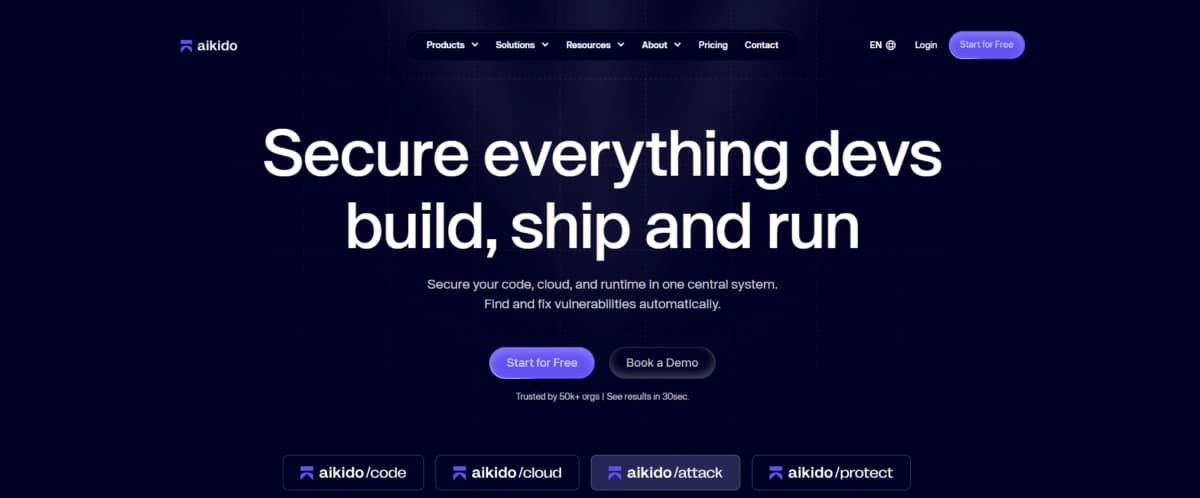
Aikido is widely regarded as one of the best Snyk alternatives, offering an all-in-one DevSecOps platform that combines application, cloud, and runtime security within a single interface.
Rather than splitting capabilities across multiple products, Aikido brings security testing, cloud posture management, dependency analysis, container protection, and runtime monitoring together in one platform. This approach helps development and security teams manage vulnerabilities, compliance requirements, and cloud risks without switching between separate tools.
The platform is designed to reduce complexity while providing broad security coverage across the software development lifecycle. It also includes several capabilities that often require higher-tier plans or additional products elsewhere, making it a popular choice for teams seeking comprehensive security visibility with predictable pricing.
Key Features:
- SAST, DAST, and Software Composition Analysis (SCA)
- Infrastructure as Code (IaC) scanning
- Container image security scanning
- Cloud Security Posture Management (CSPM)
- Secret detection inside and outside the IDE
- API security testing
- Malware scanning
- Open-source license compliance and risk scanning
- Runtime security and in-app firewall protection
- Custom local scanning and on-premises deployment options
- CI/CD integrations and developer-focused workflows
| Attribute | Value |
| Founded | 2022 |
| Best for | Teams seeking an all-in-one DevSecOps platform” is more neutral. |
| Coverage | SAST, DAST, SCA, IaC, containers, CSPM, secrets, API security, runtime security, license compliance |
| Pricing model | Predictable tiers with broad feature access |
Opengrep
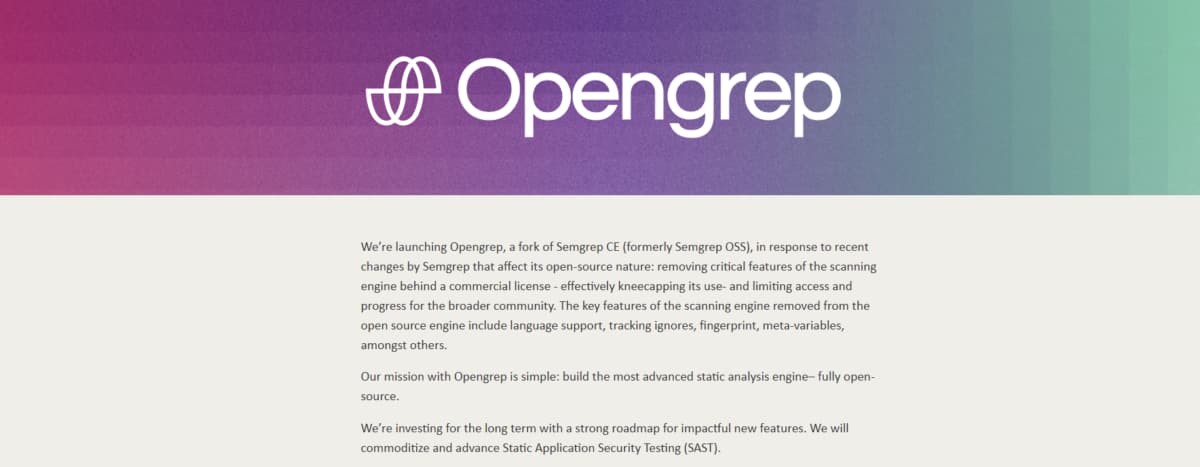
Opengrep is a fork of Semgrep CE backed by a consortium of 10+ application security organizations, built to deliver enterprise-grade static analysis without proprietary gatekeeping.
No essential features are locked behind commercial licenses—inter-procedural analysis, cross-file scanning, and extended language coverage ship in the base distribution. Teams get the full toolkit without negotiating enterprise contracts or hitting feature walls mid-project.
The platform supports Windows alongside Linux and macOS, maintains backward compatibility with JSON and SARIF outputs, and integrates into existing CI/CD pipelines without vendor lock-in. It’s designed for organizations that need audit trails and reproducible builds without subscription friction. Community governance means roadmap decisions reflect practitioner needs, not revenue targets.
| Attribute | Value |
| License Model | Fully open-source, no feature paywalls |
| Analysis Depth | Inter-procedural + cross-file scanning |
| Platform Support | Windows, Linux, macOS |
| Output Formats | JSON, SARIF (backward compatible) |
Oligo Security

Oligo Security focuses on active runtime protection across cloud, code, and AI workloads. Instead of relying only on static scans, it analyzes security in live execution environments.
The platform detects, blocks, and investigates threats in real time. At the same time, it cuts out 90-99% of vulnerability noise by confirming what’s actually exploitable based on real behavior. This helps DevSecOps teams avoid drowning in endless false-positive alerts.
It also brings runtime SCA, SBOM generation, and licensing compliance into deployment pipelines. Teams get clear visibility into what’s actually running in production, not just what was scanned earlier. Overall, Oligo bridges the gap between thousands of theoretical risks flagged by static tools and the few vulnerabilities attackers can truly reach.
| Attribute | Value |
| Best for | Teams drowning in scanner false positives |
| Core coverage | Runtime protection + exploitability proof |
| Key strength | 90-99% vulnerability noise reduction |
| Deployment | Cloud, code, AI workload integration |
Jit
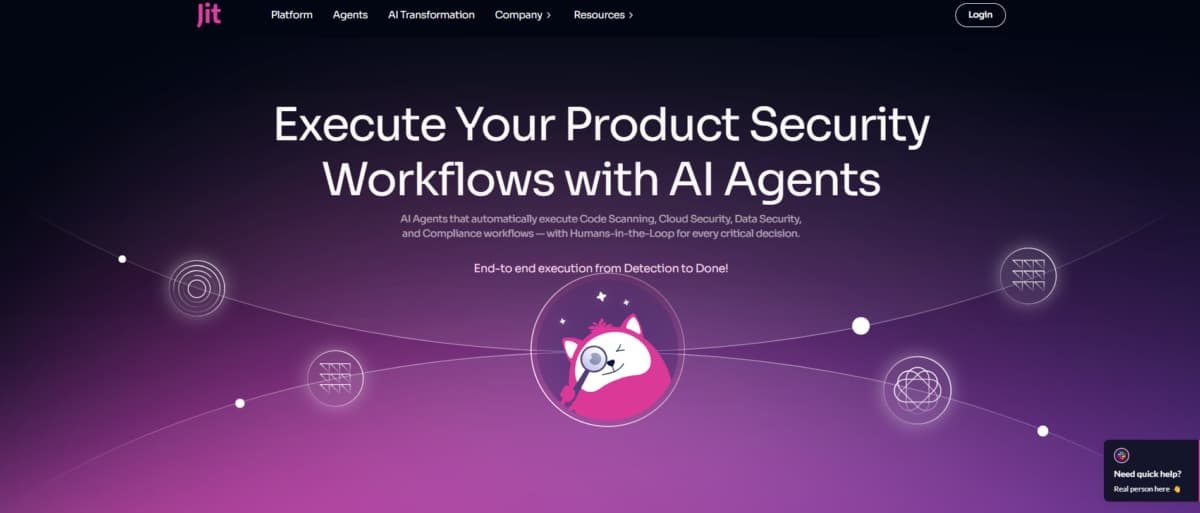
Jit stands apart by moving security work from detection to remediation inside developer workflows rather than dumping alerts into separate ticketing systems.
Context-aware AI agents query a unified context graph integrating cloud, code, runtime, scanners, identity, data, and policies, eliminating the fragmented tool sprawl that slows most DevSecOps teams. This orchestration layer covers SAST, SCA, cloud security, data security, and compliance workflows in one interface, matching Snyk’s breadth while adding the intelligence layer that prioritizes what actually matters in your environment.
The platform’s strength is correlation. By querying a unified context graph from all integrations, Jit’s AI understands which vulnerabilities are exploitable given your specific runtime configuration, deployed services, and identity posture—not just theoretical CVE scores. Worth it for teams drowning in false positives.
| Attribute | Value |
| Best for | Teams needing AI-driven prioritization across fragmented security tools |
| Key differentiator | Context-aware agents that auto-remediate inside dev workflows |
| Coverage scope | SAST, SCA, cloud, data, compliance |
| Integration model | Unified graph connecting all existing scanners and policies |
Frequently Asked Questions
Q: How much do unified DevSecOps platforms typically cost in 2026?
A: Expect $50–200 per developer/month for bundled cloud platforms. Team flat rates often start at $500/month for small groups. Open-source is free for the basics but charges for advanced runtime or compliance features. Always verify what’s included.
Q: How long does integration into CI/CD pipelines take?
A: Modern platforms connect in under 30 minutes. Initial scans appear quickly. Full rollout with policy tuning usually takes 2–4 weeks. Legacy systems can take much longer.
Q: Do these platforms offer runtime security?
A: Not all do. Many stick to pre-deployment scanning. Runtime-capable tools monitor production and block live threats. Check licensing details carefully.
Q: Can I test before buying?
A: Most offer 14–30 day trials. Open-source options allow unlimited testing but with limited support.
Methodology
We ranked six DevSecOps platforms based on unified security coverage, ease of CI/CD integration, pricing transparency, active development, and runtime capabilities.
The evaluation drew from the platforms’ own profile data — including positioning, founding year, documented features, and pricing models — along with publicly available integration guides and community signals.
Platforms that hide key features behind opaque enterprise tiers or focus too narrowly, ranked lower. We gave higher marks to those offering broad, accessible coverage across SAST, SCA, cloud, and runtime security.
Conclusion
DevSecOps teams are looking for unified security that doesn’t tie them to one vendor. The six platforms we covered bring solid overall coverage while tackling specific weak spots like runtime protection, open-source governance, and smarter remediation.
While many tools stay in their own lane, these show it’s possible to handle code, cloud, and runtime security effectively — without complicated pricing or missing pieces.
Begin by checking how your CI/CD pipeline lines up with important factors: combined SAST and SCA features, integration simplicity, transparent costs, ongoing development, and runtime capabilities.
Request trials from your top three matches, then run them in parallel on representative code. Compare alert quality and fix workflows. Ultimately, it’s the practical coverage that makes the difference.