
Fintech software has little room for “almost works.” A banking app, payment gateway, or card platform has to process transactions correctly, protect user data, pass compliance checks, and stay stable under real usage. The visible product may be a clean interface, but most of the risk sits underneath: legacy banking systems, PCI-DSS requirements, KYC and AML flows, fraud monitoring, API connections, and settlement logic. If one part is built poorly, the issue can show up later as failed payments, delayed launches, audit problems, or expensive rework. For banks and payment providers, this makes vendor choice a technical and regulatory decision, not just an outsourcing task.
We evaluated dozens of fintech software development companies and shortlisted 5 that demonstrate measurable domain expertise — not marketing fluff. These firms have published case portfolios in payment processing, core banking modernization, and regulatory compliance work. Here’s how they compare at a glance:
| Firm | Best for | Founded | Notable specialty | Geographic scope |
|---|---|---|---|---|
| Softjourn | Payment processing and prepaid platforms | 2001 | 150+ FinTech projects, 30+ published case studies | North America, UK, Ukraine, Poland, Brazil |
| RNDpoint | AI-driven fraud detection and chatbots | 2014 | 250+ tech experts, 11 years FinTech focus | Global |
| Appinventiv | Enterprise-grade digital systems | 2013 | 3000+ digital products for KFC, Adidas, IKEA | Global, Middle East presence |
| DICEUS | Insurance and system integration | 2011 | Ready-made modular insurance software | Europe, North America |
| EffectiveSoft | AI-driven workflow redesign | 2006 | 22 years, 300+ developers, 1500+ projects | — |
What Fintech Software Development Firms Actually Do
Custom banking platforms, payment gateways, and compliance automation tools form the backbone of modern financial services. Fintech software development companies build these systems from scratch or modernize legacy infrastructure that predates cloud architecture. The work splits into three categories: payment processing (card issuing, gateway integration, remittance rails), core banking modernization (account management, loan origination, regulatory reporting), and specialty applications (fraud detection, KYC automation, open banking APIs).
Banks and fintech startups bring in these firms when internal teams lack the fintech-specific experience to handle payments, compliance, or legacy integrations. The work usually starts with reviewing existing systems, mapping regulatory requirements, and finding the weak points before development begins. The harder part is choosing a vendor with real payment, banking, or compliance projects behind it, not just a software company that added “fintech” to its service page.
PCI-DSS and KYC-focused projects require specialized knowledge that generic developers don’t possess. Payment card data handling, anti-money laundering workflows, and OFAC screening aren’t skills you pick up on the fly — they’re built through repeated exposure to audits, failed integrations, and regulatory feedback loops. That’s why track record matters more than tech stack when evaluating fintech vendors.
How to Choose a Fintech Software Development Partner
- Domain-specific case portfolios — look for published projects in payment processing, core banking, or compliance automation, not vague “financial services experience”
- Regulatory compliance documentation — HIPAA, GDPR, PCI DSS, SAMA, VARA familiarity signals a firm has navigated audit processes before
- Founded year and longevity — firms operating since 2001 or earlier survived multiple fintech cycles and regulatory shifts
- Geographic coverage — cross-border payment projects require teams that understand regional banking networks and local compliance nuances
- Published pricing or tier transparency — most firms use request-a-quote models, which signals enterprise ICP but makes budget planning harder for smaller buyers
- Integration depth — Stripe, Apple Pay, Interac, First Data, Worldpay integrations demonstrate hands-on experience with real payment networks
Top 5 Fintech Software Development Companies
These 5 firms stand out for documented fintech portfolios, regulatory compliance expertise, and operational longevity. They’re not the only competent vendors in the space, but they’re the ones with verifiable track records in payment processing, core banking, and compliance-heavy projects.
1. RNDpoint
A global FinTech development services provider with 250+ tech experts and 11 years of market experience, specializing in AI-driven fraud detection and generative AI chatbot solutions for banking.
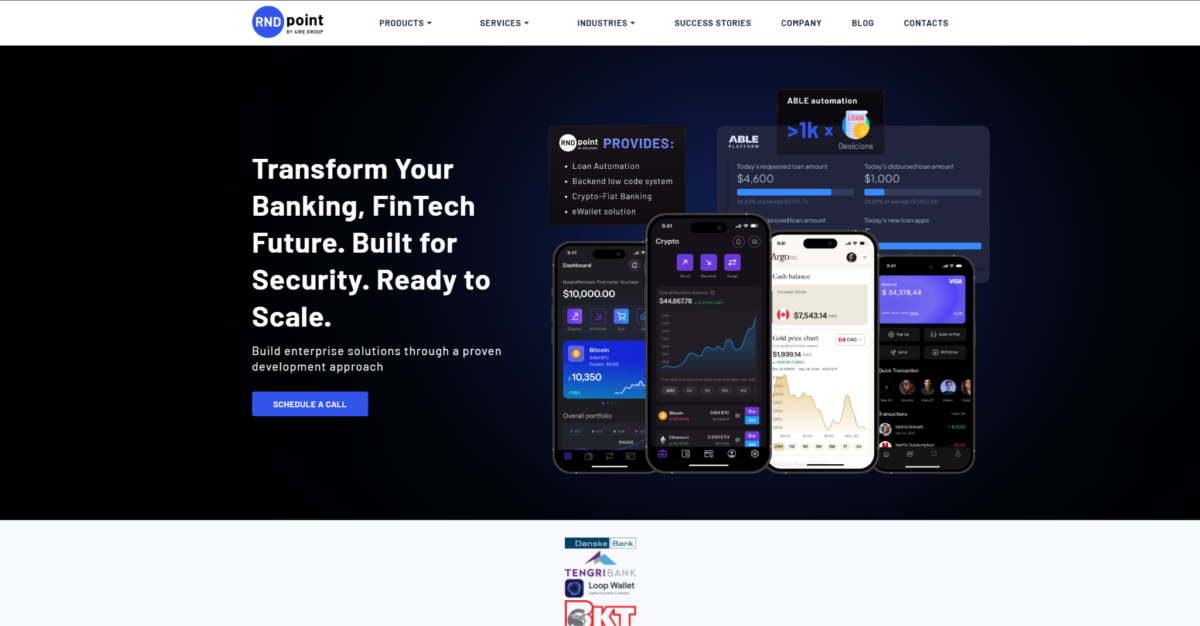
Founded in 2014, RNDpoint positions itself at the intersection of traditional fintech infrastructure and emerging AI capabilities. The firm delivers AI chatbot solutions grounded in strategic business alignment with 6+ years of specialized experience in Generative AI roll-out strategies across financial services, e-commerce, automotive, and healthcare sectors. That multi-sector exposure translates into chatbot implementations that handle complex banking workflows — account inquiries, fraud alerts, loan application status — not just FAQ scripting.
Olena Petrashchuk serves as Co-founder and CEO, with parallel leadership at MobID, suggesting experience in identity verification systems that complement banking use cases. Peter Shubenok founded ProcessMix and the ABLE lending automation platform, bringing direct lending-domain expertise into the firm’s product strategy.
| Attribute | Value |
|---|---|
| Core services | Custom software development, AI chatbot development, Generative AI development |
| AI specialties | AI fraud detection, AI agent development, AI copilot development |
| Integration focus | Software integration services, API integration |
The firm’s AI fraud detection capability is particularly relevant for payment processors facing rising synthetic identity fraud and account takeover attacks. Specific fraud detection accuracy metrics or case study results aren’t published, which makes it harder to benchmark their systems against established players like FICO or SAS.
2. Softjourn
The most experienced payment-focused developer on this list, with two decades of documented work in card issuing, prepaid platforms, and PCI-DSS compliance.

Founded in 2001, Softjourn operates with headquarters in Silicon Valley and R&D centers in Ukraine, Poland, and Brazil. The firm has delivered 150+ FinTech projects with 30+ published case studies in financial software development, covering payment processing, corporate card programs, FX trading platforms, and BNPL implementations. Its client roster includes PEX, SVB, PaySign, Viamericas, and CyberSource, names that signal real exposure to enterprise-grade payment infrastructure.
Sergiy Fitsak, the firm’s Managing Director, publishes regularly on payment engineering topics and is quoted in Forbes, Investopedia, and FinTech Weekly. That level of thought leadership suggests deep domain expertise, not surface-level marketing. The team specializes in prepaid, gift card, and corporate card platforms for card issuing, loyalty programs, and unbanked population enablement — use cases that require navigating card network rules, state money transmitter licenses, and anti-fraud systems simultaneously.
- PCI-DSS compliant payment processing with Stripe, Apple Pay, Interac, First Data, Worldpay, and Secure Check integrations
- Core banking system development and modernization
- FinTech integrations with Mulesoft, Salesforce, banking APIs, card networks, KYC/AML, OFAC/CIP compliance
- R&D practice operating since 2008 supports innovation in AI-driven automation and fraud detection
3. Appinventiv
An engineering-first firm that combines architecture rigor with AI capabilities, serving enterprise clients like KFC, Adidas, and IKEA across 35 industries.

Founded in 2013, Appinventiv operates as a global digital product engineering company with offices spanning North America, Europe, the Middle East, and Asia. The firm has delivered 3000+ digital products, though only a subset targets financial services specifically. Their positioning emphasizes secure, scalable digital systems that integrate cleanly into enterprise ecosystems — language that signals experience with the architectural complexity banks face when modernizing core systems.
Consecutive Deloitte Tech Fast 50 Awards in 2023 & 2024 confirm rapid growth and operational scale. The firm’s regulatory compliance experience includes HIPAA for healthcare clients like DiabeticU, Livia, and Shoona; GDPR for clients like Slice; PCI DSS for fintech and eCommerce engagements, including USA MedPremium; SAMA & VARA for Middle East projects following Saudi and UAE data localization and virtual asset mandates. That breadth suggests a team accustomed to navigating multi-jurisdiction compliance requirements, which matters for payment platforms operating across borders.
Pros:
- AI-First Product Engineering with disciplined execution
- Two months of free post-launch maintenance included based on agreed requirements
- Legacy system modernization with predictive capabilities
Cons:
- Portfolio spans 35 industries, which dilutes fintech-specific case study depth compared to specialists
- Pricing structure not published; enterprise engagement model may not fit smaller fintechs
The firm’s multi-industry portfolio is both a strength and a weakness. Broader exposure brings cross-sector innovation — healthcare’s HIPAA workflows inform fintech KYC design — but it also means fewer published banking case studies than pure-play fintech shops.
4. DICEUS
A product-led company specializing in insurance technology and system integration, with over a decade of experience building modular software for insurers and financial institutions.
Founded in 2011, DICEUS operates across Europe and North America with offices in Copenhagen, Wrocław, Vilnius, Vienna, Dubai, and Amman. The firm brings deep insurance DNA with ready-made, modular software products that help insurers launch fast and scale faster — a positioning that overlaps with fintech when banks offer embedded insurance products or when payment platforms need policy-based risk management.
Illia Pinchuk founded the firm and remains actively involved, with Kateryna Monastyrska leading sales and marketing and Dmytro Kazymir heading growth. The leadership team’s stability over 14 years signals operational maturity.
- Custom software development, web development outsourcing, and mobile app development
- Software testing and QA, IT infrastructure services
- Cybersecurity services
The firm’s insurance focus means their compliance expertise skews toward Solvency II, GDPR, and local insurance regulations rather than PCI-DSS or PSD2. Specific payment processing or core banking case studies aren’t documented in available materials, which limits their fit for pure-play payment platforms. However, banks building insurance distribution channels or embedded finance products would benefit from their modular product approach.
5. EffectiveSoft
A firm that applies AI to complex operational environments, helping operationally complex companies redesign workflows and decision-making systems.
Founded in 2006, EffectiveSoft operates with 300+ professional developers and 1500+ successful projects over 22 years. The firm’s positioning emphasizes redesigning workflows, systems, and decision-making for the AI era — language that suggests experience with the kind of process re-engineering banks undertake when moving from batch processing to real-time payment rails.
| Attribute | Value |
|---|---|
| Core capabilities | Custom software development, AI integration, Machine learning |
| Modernization focus | Cloud migration, Mobile app development, Web application development |
| Enterprise tooling | Enterprise desktop software, Business analysis |
| Scale indicators | 300+ developers, 1500+ projects, 22 years operational |
EffectiveSoft also works with major cloud platforms, including Microsoft Azure, AWS, Google Cloud Platform, and Oracle Cloud Infrastructure. This makes the company relevant for financial organizations that need to modernize older systems or move parts of their infrastructure into a cloud or hybrid environment. Its experience with Salesforce, Dynamics 365, SharePoint, and Office 365 may also be useful for banks and fintech companies already working inside Microsoft-heavy internal ecosystems.
The weaker point is fintech specialization. Publicly available materials do not show many clear payment processing or core banking case studies, so EffectiveSoft is harder to compare with more focused vendors like Softjourn. The company looks more suitable for AI workflow automation, cloud migration, enterprise software support, and long-term engineering capacity than for narrow payment infrastructure projects.
Final Thoughts
Fintech development is one of those areas where a weak vendor choice usually shows up late, when the product is already tied to payment rails, compliance checks, and customer data flows. That is why the comparison should start with the type of system being built. Card issuing, payment gateways, lending platforms, fraud tools, and banking modernization projects all require different technical habits and different levels of regulatory experience.
Softjourn looks strongest where payment infrastructure, prepaid platforms, and card-related products are the priority. RNDpoint is more relevant for teams exploring AI use cases in fraud detection or banking automation. Appinventiv brings broader enterprise product engineering, while DICEUS fits better around insurance-linked financial products. EffectiveSoft is closer to workflow modernization and long-term engineering support. The best choice is the vendor whose past work matches the hardest part of the project, not the one with the broadest service page.