
Third-party access became one of the messiest parts of enterprise security.
Not because vendors suddenly became less trustworthy. The real problem is scale. Modern organizations now depend on an enormous number of outside partners connecting into internal environments constantly. IT contractors, cloud consultants, software providers, managed service teams, infrastructure vendors, auditors, external developers, support engineers — the list keeps growing every year.
Most enterprises no longer operate as isolated environments. They operate more like interconnected ecosystems where outside access has become part of normal operations.
The security challenge starts when these access workflows become difficult to control consistently.
One vendor received permanent credentials because temporary access felt inconvenient. Another connects through unsecured remote workflows that nobody reviewed properly. Somebody forgets to disable contractor permissions after a project ends. Shared administrator accounts quietly circulate between external teams because onboarding processes move faster than governance policies.
This is exactly why third-party access became a major focus area inside modern PAM platforms.
Organizations now want more than credential storage. They want visibility into external sessions, tighter access approvals, temporary privilege controls, centralized auditing, and the ability to monitor vendor activity without slowing operations down completely.
The strongest PAM vendors increasingly treat third-party access as a core security problem instead of a secondary feature.
Here are five PAM platforms organizations frequently evaluate for managing external access across modern enterprise environments.
1. BeyondTrust
BeyondTrust became highly relevant for organizations managing large volumes of remote vendor access across distributed enterprise environments.
The platform focuses heavily on controlling remote privileged sessions while reducing unnecessary standing privileges for external users.
Capabilities include:
- Privileged remote access
- Endpoint privilege management
- Session monitoring
- Credential management
- Vendor access security
- Least privilege enforcement
One reason BeyondTrust gained traction in third-party access scenarios is that many enterprises realized external vendors no longer operate occasionally inside infrastructure. In many organizations, vendors connect continuously for maintenance, support, development, monitoring, and cloud operations.
That creates a completely different operational reality compared to older perimeter-based access models.
BeyondTrust focuses strongly on securing these workflows while improving visibility into privileged remote sessions across distributed environments.
2. Syteca
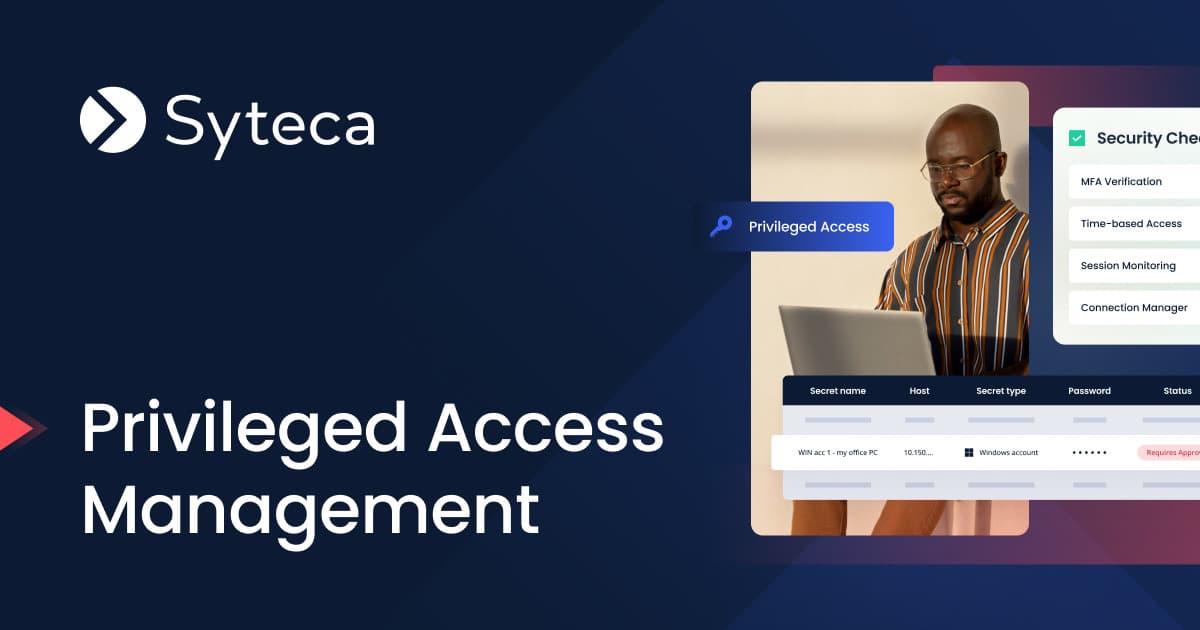
Syteca privileged access management stands out particularly well in third-party access scenarios because the platform focuses heavily on session visibility and real-time behavioral monitoring instead of relying only on static credential controls.
That difference matters because vendor access risks rarely come from credentials alone.
A contractor may technically use approved credentials while still accessing unusual systems, transferring sensitive files, or behaving differently from expected workflows during the session itself. Traditional access controls often miss those situations entirely because the login technically appears legitimate.
Syteca approaches this through continuous session intelligence and integrated identity threat detection capabilities built directly into the platform.
Core functionality includes:
- Credential vaulting
- Secure vendor access workflows
- Session recording
- Real-time alerts
- Continuous session validation
- Privileged elevation management
- Multi-factor authentication
- Automated response actions
- Session blocking
- Just-in-time access provisioning
The platform also supports cloud, hybrid, and fully on-premises environments without forcing organizations into infrastructure-heavy deployment projects before external access governance becomes operational.
That flexibility matters because vendor access workflows often span multiple environments simultaneously. A third-party contractor may need temporary access to cloud infrastructure, internal systems, remote endpoints, and sensitive administrative environments during the same project lifecycle.
Syteca gives security teams strong visibility into those sessions while keeping onboarding and operational management relatively manageable compared to some legacy enterprise PAM ecosystems.
3. CyberArk
CyberArk remains one of the most recognized enterprise PAM vendors largely because of its scalability across highly complex infrastructure environments.
The platform includes strong third-party access management capabilities integrated into broader privileged access and identity security workflows.
Core functionality includes:
- Credential vaulting
- Privileged session management
- Secure remote access
- Endpoint privilege controls
- Secrets management
- Identity security integrations
CyberArk is frequently evaluated by large enterprises managing highly segmented infrastructure where external access governance must align closely with broader identity security programs and compliance requirements.
The platform’s depth works especially well for organizations operating mature security operations environments with extensive governance policies around external privileged access.
At the same time, implementation complexity can become a consideration for organizations seeking lighter operational workflows.
4. WALLIX

WALLIX focuses heavily on session traceability and operational oversight around privileged activity, which makes the platform particularly relevant for organizations managing external vendors and contractors.
Third-party access introduces visibility problems very quickly once multiple outside users start accessing distributed systems simultaneously.
WALLIX addresses this through centralized session oversight capabilities, such as:
- Session recording
- Secure remote access
- Access governance
- Privileged account management
- Credential protection
- Compliance reporting
The platform is especially relevant for regulated industries where organizations need detailed auditing and visibility into contractor activity across internal systems.
Compared to broader identity ecosystems, WALLIX often feels more concentrated around operational governance and privileged session transparency itself.
That focus appeals strongly to enterprises trying to tighten oversight around vendor activity without overcomplicating remote access workflows.
5. Delinea
Delinea approaches third-party access management with a strong emphasis on usability and operational simplicity.
A lot of organizations struggle because external access governance becomes too difficult administratively. Temporary access requests pile up. Approval workflows slow down projects. Security controls become frustrating enough that teams eventually work around them instead of following them consistently.
Delinea tries to reduce that friction.
The platform supports hybrid environments while balancing privileged access controls with more manageable administrative workflows.
Capabilities include:
- Credential vaulting
- Session management
- Behavioral analytics
- Least privilege controls
- Access governance
- Application access security
Delinea is frequently evaluated by organizations trying to strengthen third-party access security without introducing unnecessary operational bottlenecks around vendor collaboration itself.
That balance becomes increasingly important as enterprises continue relying more heavily on outside providers across infrastructure, cloud operations, and software environments.
Third-party access became harder to control because the infrastructure became fragmented
One reason vendor access became so difficult to manage is that enterprise infrastructure itself stopped behaving like a centralized environment.
Years ago, most third-party access happened through relatively contained internal networks.
Now vendors connect to cloud systems, SaaS applications, hybrid environments, remote endpoints, DevOps infrastructure, and distributed administrative environments simultaneously. Some access lasts a few hours. Some relationships continue for years. Visibility becomes fragmented very quickly once multiple external users operate across different systems at the same time.
Traditional access management approaches struggle in these environments because static permissions alone no longer provide enough control.
Organizations increasingly need visibility into behavior, sessions, and activity patterns during external access itself.
Security teams now care more about session visibility than permanent credentials
One of the biggest shifts inside PAM strategy is how organizations think about external privileged access.
For years, the conversation focused mostly on protecting credentials.
Now, many enterprises care just as much about understanding what external users actually do during sessions.
That includes:
- Session visibility
- Temporary privilege controls
- Real-time behavioral monitoring
- Remote access governance
- Continuous validation
- Automated response capabilities
The strongest PAM platforms increasingly combine these capabilities into centralized operational workflows instead of treating third-party access as a disconnected feature.
Modern PAM platforms are becoming external access control layers
Third-party access is no longer a niche security problem. In many enterprises, vendors, contractors, and external providers interact with critical systems constantly. That reality forced PAM platforms to evolve into broader visibility and governance environments capable of managing privileged activity far beyond internal administrator workflows alone.
Syteca stands out especially well here because the platform combines privileged access management with continuous session intelligence and integrated identity threat detection capabilities across external access workflows.
For many organizations today, managing third-party access is no longer simply about granting permissions securely.
It is about maintaining visibility once outside users enter the environment in the first place.