
For years, product engineering teams optimized for speed mostly by improving execution. Faster sprints. Faster deployments. Faster testing. Faster releases. Engineering organizations introduced DevOps practices, CI/CD automation, cloud-native infrastructure, platform engineering, and eventually AI coding assistants to reduce repetitive development work.
But many teams eventually ran into the same limitation. Delivery workflows themselves were becoming harder to manage.
As enterprise systems scaled, engineering organizations accumulated operational complexity everywhere. Product documentation fragmented across systems. Requirements drifted between teams. Architecture decisions became difficult to trace. QA environments struggled to keep pace with release velocity. Operational knowledge stayed trapped inside individuals instead of flowing across delivery pipelines.
This is where AI is beginning to reshape product engineering much more fundamentally. The bigger shift is no longer about helping developers generate code faster. It is about rebuilding the workflow layer surrounding software delivery itself.
Engineering organizations increasingly want AI embedded into coordination, planning, architecture analysis, testing operations, infrastructure workflows, and delivery governance across the SDLC.
That creates a very different category of engineering transformation. The companies attracting attention now are usually the ones helping enterprises redesign software delivery operations around AI-assisted workflow orchestration instead of isolated productivity tooling.
Here are four companies enterprises increasingly evaluate as AI-native product engineering evolves.
1. Avenga

Avenga AI driven software development company approaches AI-enhanced product engineering through operational workflow transformation rather than standalone development acceleration.
That distinction matters because most delivery inefficiencies appear between engineering stages rather than inside coding environments alone.
Requirements evolve without clear traceability. Architecture decisions become inconsistent across teams. QA cycles create delays under release pressure. Incident response workflows depend heavily on fragmented operational context. Coordination overhead increases as engineering ecosystems scale.
Avenga’s AI-driven software development services focus heavily on embedding AI into those operational delivery layers.
The company supports AI integration across:
- Estimation and planning workflows
- Requirements engineering
- UX and design operations
- Architecture analysis
- Engineering execution
- QA automation
- DevSecOps coordination
- Incident response environments
One especially interesting part of Avenga’s model is the emphasis on AI orchestration across delivery roles.
A lot of enterprises already have developers experimenting with AI independently. But disconnected AI adoption often creates inconsistent workflows and fragmented operational visibility across engineering organizations.
Avenga’s Intelligent Flow framework approaches AI differently. Instead of introducing isolated productivity tooling, the framework standardizes AI integration across the SDLC itself while connecting AI systems directly into delivery operations and engineering workflows.
Another strong differentiator is role-based AI integration. Product managers, architects, QA specialists, developers, and infrastructure teams operate with AI systems aligned to their own workflow context instead of relying on generic assistants disconnected from operational engineering environments.
That creates significantly more continuity across product delivery systems.
The company also places heavy emphasis on long-term human-agent collaboration models where AI becomes embedded into engineering coordination continuously rather than temporarily accelerating isolated tasks.
Avenga combines this AI-native workflow model with broader modernization expertise involving enterprise product engineering, cloud infrastructure transformation, operational scalability, and governance-heavy delivery ecosystems.
2. SoftServe
SoftServe has invested heavily in AI-enhanced engineering operations and enterprise delivery modernization initiatives.
The company supports organizations embedding AI into software delivery workflows involving distributed engineering teams, cloud-native infrastructure, enterprise applications, and analytics ecosystems.
Capabilities include:
- AI-driven engineering modernization
- Enterprise AI implementation
- Workflow optimization
- QA automation
- Cloud-native delivery systems
- Data and analytics engineering
SoftServe is especially relevant for enterprises modernizing large operational engineering ecosystems where AI adoption intersects with broader infrastructure and workflow transformation initiatives.
One reason organizations evaluate the company is delivery coordination at scale. AI-enhanced product engineering environments become operationally complicated once implementation expands across engineering squads, governance systems, testing operations, and infrastructure environments simultaneously. SoftServe supports those broader transformation ecosystems effectively.
The company also brings broader expertise across analytics modernization, operational redesign, and cloud engineering connected to enterprise software delivery.
3. N-iX
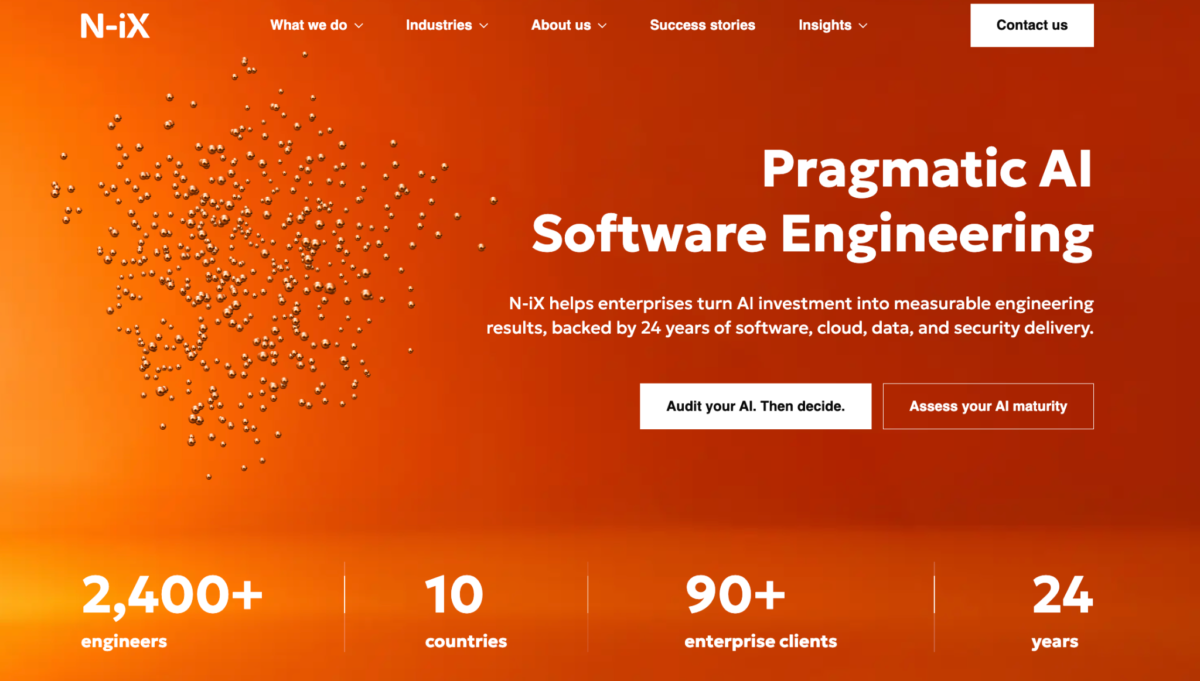
N-iX has expanded its AI engineering capabilities significantly across enterprise software modernization and AI-enhanced product delivery ecosystems.
The company works with organizations integrating AI systems into cloud-native engineering operations and distributed software delivery environments.
Capabilities include:
- AI engineering
- Workflow automation
- SDLC modernization
- Enterprise product development
- Cloud-native delivery systems
- Data engineering
N-iX is especially relevant for organizations operationalizing AI across broader engineering workflows rather than isolated development environments.
One major strength is infrastructure coordination.
AI-native engineering ecosystems often require synchronization between delivery pipelines, testing environments, DevOps systems, cloud platforms, and governance operations simultaneously. N-iX supports those implementation environments particularly well.
The company also works heavily across modernization initiatives involving scalable engineering operations and distributed product delivery systems.
4. Intellias
Intellias has expanded its AI engineering capabilities significantly across enterprise product engineering and operational modernization environments.
The company supports organizations embedding AI systems into distributed software delivery ecosystems involving cloud-native infrastructure and enterprise-scale engineering operations.
Capabilities include:
- AI-assisted engineering
- Product delivery optimization
- Workflow automation
- Enterprise platform engineering
- Cloud-native systems
- Data infrastructure
Intellias is especially relevant for enterprises combining AI adoption with broader engineering transformation strategies.
A strong advantage is operational systems integration. AI-enhanced delivery workflows eventually need to interact with architecture governance, DevOps environments, QA systems, infrastructure platforms, and enterprise engineering operations simultaneously. Intellias supports those integration-heavy ecosystems effectively.
The company also works across modernization initiatives involving cloud transformation and platform engineering.
Product engineering is becoming more workflow-centric
One of the more important changes happening right now is where enterprises believe engineering value actually comes from.
Historically, software delivery optimization focused heavily on individual execution efficiency. Now organizations increasingly understand that delivery speed depends just as much on workflow continuity between engineering stages.
Planning, architecture, testing, infrastructure operations, deployment governance, and incident management all influence delivery velocity continuously.
AI is beginning to reconnect those operational layers. Requirements systems feed QA workflows more dynamically. Architecture analysis gains more context. Incident response workflows surface engineering history automatically. Operational knowledge becomes easier to preserve across teams instead of remaining trapped inside fragmented systems or individuals.
That creates a very different engineering environment than the original coding assistant wave. The organizations moving fastest right now are usually not the ones deploying the most AI tools individually. They are the ones rebuilding the workflow layer around software delivery itself.
And honestly, that shift is probably where the larger enterprise transformation actually begins.