
Fintech companies, SaaS platforms, and enterprises face a common problem when developing financial products. Integrating individually with thousands of banks is prohibitively expensive, while achieving proper PSD2 compliance requires specialised legal and technical resources that most teams lack.
The wrong Open Banking provider can lock you into inflexible pricing structures, incomplete bank networks, or confusing API behaviour that only becomes apparent after going live.
To help cut through the noise, this review evaluates five providers across three key areas: the breadth of their bank coverage, the maturity of their infrastructure (founded year and regulatory standing), and the documented strength of both their AIS and PIS offerings.
We focused only on platforms that provide clear API documentation and hold explicit PSD2 licences.
What Open Banking APIs Do and Why This Category Exists
Open Banking came about because of PSD2. The regulation forced European banks to expose customer data and payment capabilities through standardised APIs.
Thanks to this, companies can now access bank accounts and move money on behalf of users without the nightmare of integrating with hundreds of banks individually. That old approach demanded huge technical teams and years of work.
Three main groups use these services today. Fintech startups creating personal finance apps, SaaS companies adding embedded finance features, and bigger enterprises that want to replace slow legacy systems with modern account-to-account payments.
The real value sits in that centralised layer. It handles onboarding, reduces fraud risk, supports cash flow insights, underwriting, and instant transfers — while quietly managing all the different bank rules and login flows in the background.
Things moved faster once PSD2 was fully enforced in 2021. That said, the space is still fragmented. No provider connects to every bank on the planet, so you have to look closely at coverage and which standards they support — Berlin Group, UK Open Banking, FDX, and so on.
Top 5 Open Banking APIs for 2026
As Open Banking becomes critical infrastructure, choosing the right API provider impacts deployment speed, compliance, and conversion rates. These five platforms lead for 2026.
Finexer
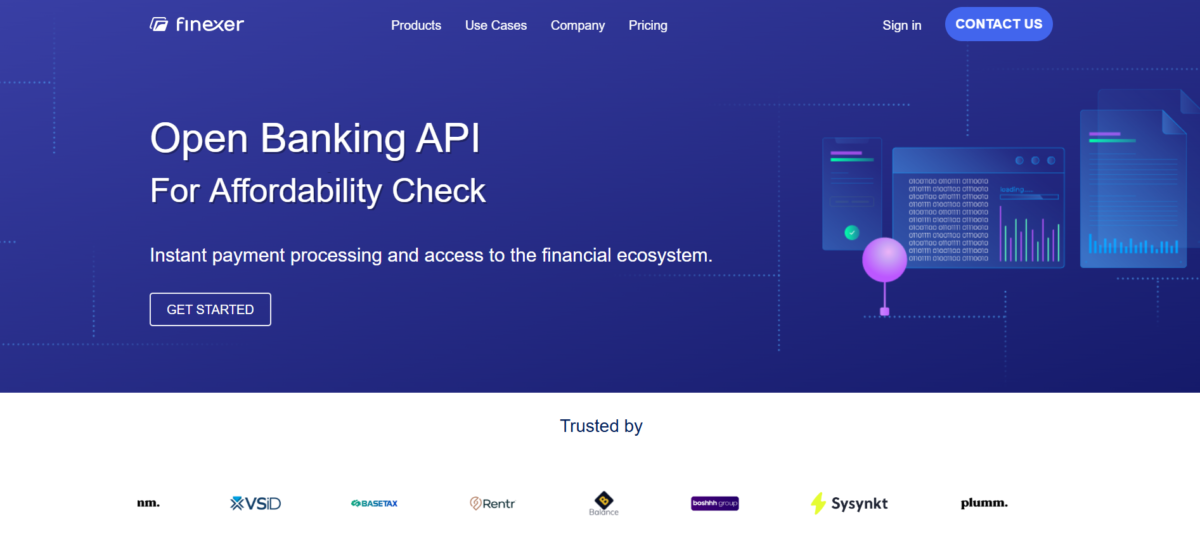
Finexer is a UK-based, FCA-authorised Open Banking infrastructure provider built for scaling SaaS platforms.
Founded in 2019, the company targets businesses that need to integrate both account information services and payment initiation without the multi-month implementation timelines typical of older providers. 99% UK bank coverage with real-time, audit-ready financial data makes it a strong fit for platforms serving UK SMBs or consumer finance applications where data freshness directly impacts underwriting or fraud decisions.
The platform’s core value proposition centers on speed: a B2B and Bank-to-Bank technological solution based on the latest Open Banking technology that enables clients to access millions of bank accounts across Europe and make payments using bank details such as IBAN, or sort code and account number.
This eliminates manual card details and multi-step authentication flows, reducing checkout friction in embedded payments.
Core capabilities:
| Feature | Application |
| Bank Transactional Data | Real-time transaction feeds for expense tracking, cash flow analysis |
| Instant Payments | Sub-minute account-to-account transfers |
| Batch Payouts | Bulk disbursement for gig economy or marketplace platforms |
| Identity Verification | KYC workflows tied to live bank account ownership |
Pricing follows a tiered structure:
- Startup (discounted pricing, white-label solution, unlimited Finexer accounts).
- Standard (standard pricing, white label solution).
- Enterprise (volume-based pricing, account management, migration assistance).
No setup fees, no hidden fees, no cancellation fees remove common friction points in early-stage negotiations.
All available features like Dashboard, Connect, and White Label – customization solution are included regardless of the plan, which simplifies feature access across customer segments.
Tink
Tink is a European Open Banking and financial data platform owned by Visa that provides payment services, account verification, and data enrichment solutions for banks, fintech companies, lenders, and payment providers.
Founded in 2012, the Stockholm-based company operates one of the continent’s most mature Open Banking networks, connecting to 3000+ banks and financial institutions across Europe through a single API integration. Visa’s 2022 acquisition brought additional compliance resources and payment network synergies, though the platform retains its standalone brand and developer-facing operations.
Tink’s primary differentiation lies in geographic breadth and data enrichment depth. Data enrichment transforms raw transaction strings into categorized, merchant-identified records useful for personal finance management, expense analysis, and credit risk modeling.
Tink provides 4 background refreshes every 24h, ensuring financial data stays current without requiring end-user re-authentication — critical for lending platforms that monitor borrower cash flow between payment cycles.
Product suite breakdown:
- Account aggregation — Multi-account dashboards for wealth management and budgeting apps.
- Payment initiation — Direct bank transfers for e-commerce checkout and bill payment.
- Income verification — Automated salary detection for mortgage and credit underwriting.
- Risk decisioning — Transaction pattern analysis for fraud prevention and affordability checks.
Pricing operates on two tracks: Standard uses a pay-per-transaction model, while Enterprise offers custom pricing with guaranteed SLAs and dedicated support.
The pricing varies depending on the needs of the company, for instance, the required level of support or guaranteed service level. There is no pay-per-use option; you can create a free account to try Tink products with test data in a sandbox environment before upgrading.
Plaid
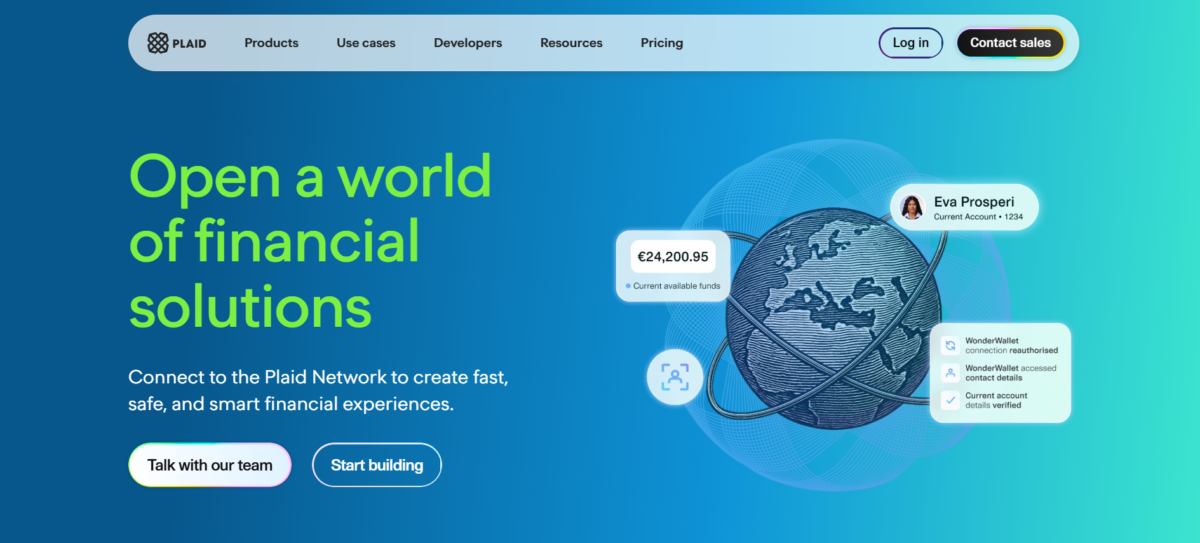
Plaid is a financial infrastructure and Open Banking platform that helps businesses connect to bank accounts, access real-time financial data, and support secure account-to-account payments.
Founded in 2013 and headquartered in San Francisco, the company operates the world’s largest open banking data network, connecting to 12,000+ financial institutions across 20 markets with 100M+ global users. This scale advantage makes Plaid the default choice for consumer fintech applications requiring broad international coverage or serving multi-market user bases.
Plaid is regulated under PSD2 in Europe and provides Account Information Services (AIS) and Payment Initiation Services (PIS) through authorised entities supervised by the FCA in the UK and De Nederlandsche Bank in the Netherlands.
The company holds licenses in multiple jurisdictions, removing the compliance burden from customers who would otherwise need to become regulated entities themselves.
Pros and cons:
| Strengths | Limitations |
| Largest global bank coverage (12,000+ institutions) | No public case studies or conversion benchmarks |
| 100M+ user network effects reduce authentication friction | No published pricing tiers — custom quotes only |
| Multi-jurisdiction licensing (FCA, DNB, US state MTLs) |
The platform’s feature set spans Account linking, Payments, Fraud prevention, Identity verification, Transaction data, Income verification, KYC & AML compliance, and Balance checks.
This breadth supports use cases from neobank onboarding (where identity + balance checks run in parallel) to lending underwriting (where income verification + transaction history inform credit decisions).
Salt Edge
Salt Edge builds open banking API solutions that empower businesses to create smart services for their customers.
Founded in 2013, the company operates one of the industry’s broadest geographic footprints, connecting to 5,000+ banks across 50+ countries. Its primary value proposition targets businesses that want to launch Open Banking features without acquiring their own PSD2 license: You can explore countless possibilities and innovate without acquiring your own open banking licence or certificates — instead, you can use Salt Edge’s.
The platform emphasizes compliance depth and API standard flexibility. Salt Edge supports all major API standards, including the Berlin Group, UK Open Banking, CDR (Australia), Saudi Arabia, Brazil, FDX (US), and more.
This multi-standard support matters for businesses operating across regulatory regimes where each jurisdiction mandates different technical specifications. Salt Edge is ISO 27001-certified and PSD2-licensed, employing the highest international security standards, which satisfy security questionnaires from enterprise procurement teams.
Main features include:
- Data aggregation — Multi-bank account views for personal finance apps.
- Payment initiation — Direct bank transfers for bill payment and merchant checkout.
- Customer onboarding & KYC — Account ownership verification tied to live bank connections.
- Multi-banking services — White-label infrastructure for banks launching aggregation features.
- Mobile SCA authentication — Strong Customer Authentication flows optimized for mobile UX.
The company’s integration partnerships include Finastra, Mambu, Temenos, and Thought Machine — core banking platforms used by traditional banks, modernizing their technology stacks. This signals Salt Edge’s positioning as infrastructure for financial institutions building Open Banking features, not just fintech startups.
Trustly
Trustly is a global Pay by Bank and Open Banking payments platform that enables businesses to accept instant account-to-account payments, recurring payments, deposits, payouts, and financial data services through direct bank connections.
Founded in 2008 and headquartered in Stockholm, the company operates the longest-running Open Banking infrastructure in this comparison. Trustly connects thousands of merchants with hundreds of millions of consumers through a large-scale Open Banking payment network operating across multiple international markets.
Unlike data-first providers (Plaid, Tink) that emphasize account aggregation and verification, Trustly’s product strategy centers on payment conversion optimization. The company provides data-driven payment optimisation through its Trustly Azura engine, which helps personalise checkout experiences, speed up payment flows, and improve conversion performance.
This AI-driven approach analyzes transaction patterns, bank selection behavior, and authentication success rates to dynamically adjust checkout flows — valuable for ecommerce merchants where 1-2% conversion lifts directly impact revenue.
Key differentiators:
- Payment-first architecture (checkout UX optimization vs data aggregation depth).
- Azura personalization engine for conversion rate improvement.
- 16-year operational track record (longest-tenured provider in this review).
- Direct integrations and plug-and-play payment connectivity through major payment service providers (PSPs).
The platform supports instant bank transfers, automated recurring payments, customer verification, onboarding workflows, and cross-border payouts for industries including ecommerce, travel, gaming, subscription services, utilities, and financial services.
Recurring payment capabilities suit subscription businesses migrating away from card networks to reduce interchange fees, while cross-border payout features serve gig economy platforms disbursing earnings to international workers.
How to Choose an Open Banking API Provider
Evaluating Open Banking providers comes down to aligning their strengths with your use case and customer geography. Focus on these practical factors:
- Bank coverage and geographic scope — Prioritise real support in your target markets over big headline numbers. Demand clear lists of institutions.
- Regulatory licensing — Choose providers with their own PSD2 authorisation for AIS and PIS. It saves you significant compliance effort.
- Maturity — Older platforms tend to be more battle-tested; newer ones often innovate faster.
- API design — Unified APIs reduce complexity if you need data access, payments, and verification. Specialised ones may suit narrower needs.
- Pricing model — Transparent tiers work better for most teams. Quote-only pricing usually targets larger enterprises.
- Developer experience — Test their sandbox, SDKs, and documentation quality before deciding.
Conclusion
At the end of the day, the best Open Banking provider depends on your geographic focus, feature requirements, and how fast you need to launch.
Larger networks tend to reduce authentication friction, while strong local coverage helps in concentrated markets. Broad connections can simplify European expansion by handling integrations and compliance for you. Global ambitions, on the other hand, need a wide bank reach across many countries.
Run a proper proof-of-concept in the sandbox first. Test the flows that matter most to you before committing to a long contract.